Mensa Brands has invested in homegrown online gardening solutions brand, TrustBasket.
Founded in 2015 by Santhosh Appaji, Santhosh Kumar N and Shekar N, TrustBasket offers a range of gardening solutions catering to different consumer segments — from gardening kits for hobbyists to compost makers and specialised soils for professionals.
TrustBasket’s products are available on its D2C website, Amazon, and other ecommerce platforms. Since its inception, the startup has served over 1.2 million customers, the company said in a statement.
“As a unique, consumer-centric brand, TrustBasket is an exciting new addition to our digital-first portfolio of brands and marks our first investment in the home gardening space,” said Ananth Narayanan, Founder and CEO of Mensa Brands.
“We believe this partnership has immense potential. Together we will cater to the end-to-end needs of new-age gardeners to help them experience the joy of gardening. We have charted out a five-year strategic plan for the brand and with our expertise in building digital-first brands. I am confident that TrustBasket will be a household name, known for its strong community and customer experience,” he added.
Mensa Brands is building a tech-led house of brands by investing in and scaling up digital-first brands across diverse categories including fashion and apparel, home and garden, beauty, and personal care.
“TrustBasket’s journey started with a few friends coming together and working towards filling a gap in the market. In the last six years, we have witnessed rapid growth, serving more than a million consumers with our high-quality products,” said Santhosh Appaji, Co-founder, TrustBasket.
“With Mensa team’s support, TrustBasket will be able to consolidate the domestic market and expand our reach to international markets.”
This is the third acquisition Mensa has made in 2022 after leather brand Estalon and aromatherapy D2C brand Florona.
Edited by Kanishk Singh
Author :- Amisha Agarwal ( )
Source :- https://yourstory.com/2022/01/mensa-brands-acquires-majority-stake-gardening-startup-trustbasket
Date :-January 24, 2022 at 07:45PM
Year after year the global interest in crypto money is growing beyond all predictions. Even the COVID-19 led challenges of 2021 couldn’t hinder the arrival of new layer-1 blockchain networks. Exactly why, there was a swathe of DeFi wallet developmentservices that supercharged the successful launch of crypto products. For the users, it's an exciting alternative to invest and generate passive income. For blockchain development company Antier, this is a goldmine of opportunity for the Indian blockchain fraternity.
Confident about India’s stature in the industry, Vikram R Singh, CEO, Antier Solutions shares, “Cryptos have been around for more than a decade now. However, 2021 was different. Not only did it introduce new blockchains but also put India on the global map. Today, 7.3 percent of the country’s population is investing in cryptocurrencies. Keeping this in mind, it is imperative for businesses to accept and enable cryptocurrency payments. The first step to that is building a crypto wallet and India will surely be the biggest market.”
This assessment could hit the bull’s eye because India already ranks second in terms of crypto adoption. In fact, the country was one of the fastest adopters of fintech digital solutions even before cryptos. More than 200 million people were using online banking before cryptos became popular here. This testifies the preparedness of the users and services providers alike to lead the Crypto DeFi wallet developmentindustry.
Understanding the popularity of crypto wallets
Crypto wallets are like any other payment wallet, built specifically for cryptocurrencies like Bitcoin, Ether, etc. They allow owners to store, trade, and buy or sell their cryptocurrency securely. A wallet comprises two types of keys - public and private. While the public key is like a public address which owners use to receive crypto, the private key is like the personal password which enables the owner to transfer currencies from their wallet to another.
The demand for cryptocurrency wallet developmentis soaring because they are the gateways to faster and safer peer-2-peer transactions across demographics.
As per a Forrester study, merchants who accept Bitcoin attract new customers and sales. Their purchase amounts are almost twice that of credit card users. Therefore, banks and other finance services providers don’t want to miss the unearthed potential. As an experienced DeFi development company, Antier understands this space in and out. The company has launched 100+ crypto products for a wide range of enterprises.
Launch your crypto wallet in less than 15 days
In the past three years, there have been multiple crypto wallet development services that cover a spectrum of solutions. These include centralised wallet development, decentralised wallet development, NFT wallet development, multicurrency wallet development, mobile wallet development, and web wallet development.
As one of the earliest Indian entrants in the industry, Antier leads the pack with fully customised and ready-to-deploy wallets. Vikram explains, “We receive numerous wallet development requests every day and the greatest challenge for most of these businesses is the stakeholder pressure to arrive early. Our white label solution is specifically designed for small-medium scale businesses who want to launch their platforms in record timelines. So performing a fast track go-to-market project takes 15 days. That covers most of the essential features.”
Antier’s DeFi crypto wallet services include mobile wallets, web wallets, hardware wallets, and desktop wallets. Apart from signature features such as cash-out, vendor payments, swapping, in-chat transactions, staking, and yield farming, Antier also provides multi-language support, QR code scanner to automatically scan wallet address, automatic conversion rates, auto denial of duplicate payments, NFC (Near Field Communication) support, and multi-coin and multi-asset support.
The solutions aim to empower small and medium enterprises to raise capital and accelerate the adoption of cryptocurrencies in the market. With consistent effort and unparalleled service, the team has gone on to support over 20 global finance companies in expanding their DeFi portfolios to more currencies and investment protocols.
Web 3.0 in Action
The era, popularly known as web 3.0, rides on decentralisation and blockchain products are at the helm of it. Enterprises who have woken up to the transformation are bound to benefit in the long haul. Needless to say, the Indian tech community will exercise its super power of learning new technologies faster than anyone else. And companies like Antier will continue to hone local talent and deliver high quality products.
If you want to build your own crypto wallet, please click here.
Author :- Team YS ( )
Source :- https://yourstory.com/2022/01/antier-solutions-leading-indias-crypto-wallet-development
Date :-January 24, 2022 at 06:40PM
Location detection technology has transformed the world immeasurably and has impacted life in ways we never imagined. GPS - the as-yet most popularly leveraged location detection technology - has transformed movement, both at a personal and population-scale level.
However, it has its accuracy limits. GPS, for instance, typically has a resolution measured from roughly 3 to 15 meters, with challenges when applied to a micro-level - which is where Vacus comes in.
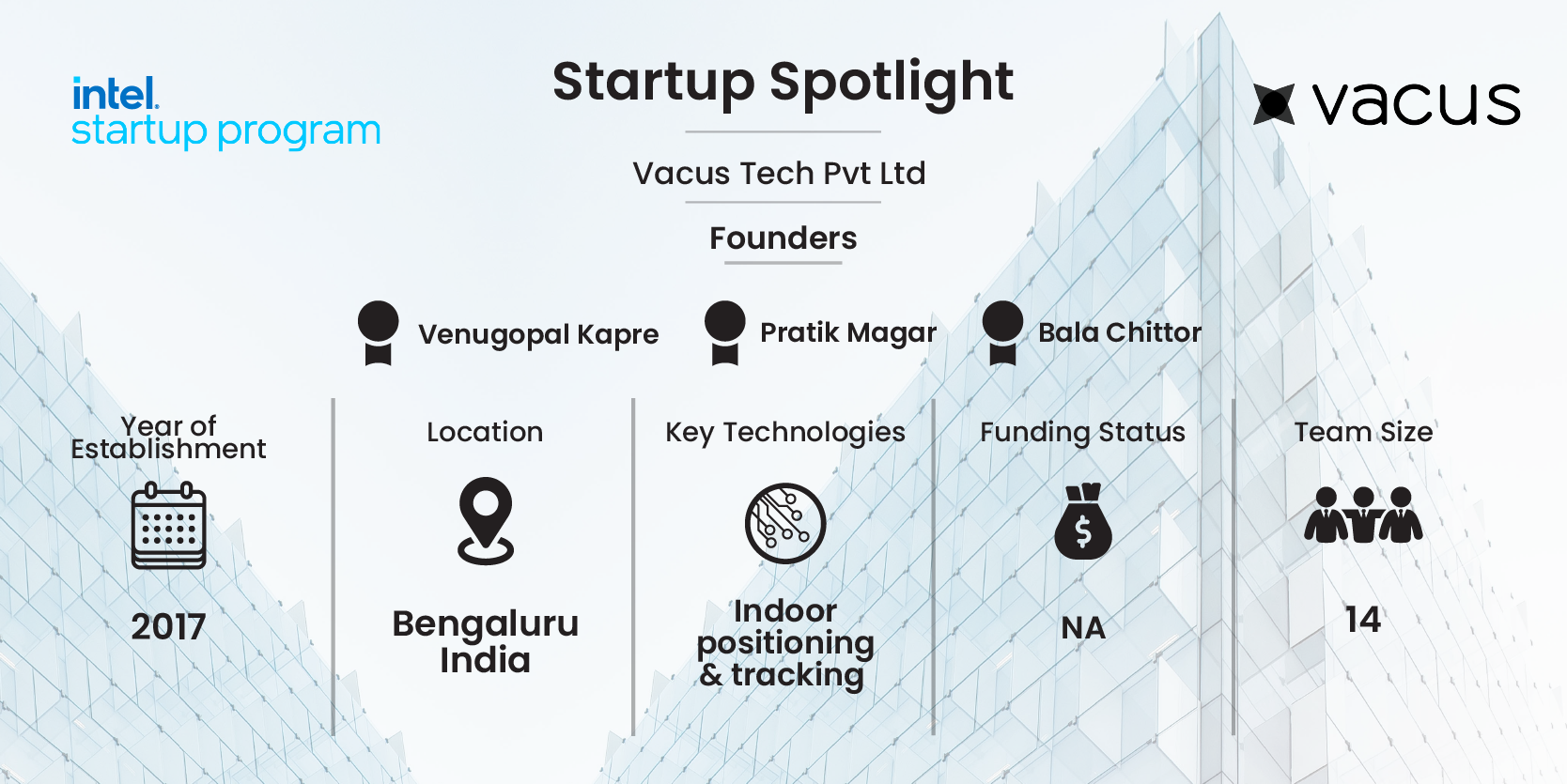
Vacus has developed what it bills as ‘the world's first indoor positioning technology’ which solves the interference immunity issue, thereby leading to scalable and accurate deployments - down to the centimeter.
It can enable businesses and individuals to achieve more with real-time accurate indoor positioning and analytics. A missing iPad, for instance, could be tagged to make it easy to find the device - down to the centimeter. In fact, the accuracy for their proprietary indoor positioning technology is 30 centimetres.
Improving the indoor micro-location technology arena
Recent research by Reports And Data reveals that the micro-location technology market is poised to reach nearly $50 billion by 2026 - catalysed by the diverse use cases and potential for the technology to solve location challenges at scale. What’s more, the APAC region is set to witness the highest CAGR of 19.2 percent during the forecast period.
While traditionally, indoor location needs were solved by use of technologies like ultra-wideband (UWB), active RFID and WiFi sensors, the technology lacks reliability, scalability and adaptability. This is largely due to the fact that the technology is sensitive to multi-paths which can interfere with its optimal working.
Vacus’ indoor positioning technology solves this interference immunity issue with its patented antenna arrangement system, thereby leading to scalable and accurate deployments. Vacus Tech develops indoor positioning solutions which use its patented radio fencing technology. Vacus’ DAS (Dual Antenna System) is a radio technology that can accurately measure the angle and direction of arrival leading to a centimeter level location measurement.
DAS is also specifically designed to mitigate radio multi-path interference propagation in a typical environment. Its solution consists of transmitters in the form of tags (that are attached to people or assets) and multi-antenna array receivers. The technology achieves centimetre-level positioning which is used to track assets and people for productivity safety enhancement.
The startup currently serves multiple business verticals including pharma, data centers, oil and gas, and transportation business verticals for asset optimisation and compliance. More recently, the technology has been leveraged to ensure accurate monitoring of social distancing and following of COVID-19 protocols while indoors.
The founding team
Founded by Venugopal Kapre, Pratik Magar and Bala Chittoor in 2017, the founding team had its origins as a hackathon team. Venugopal’s strengths lay in communication tech – having prior patents in the wireless communication domain. Pratik and Bala’s expertise lay in sales and marketing and were key in expanding the use cases for the solution.
“Prior to the pandemic, our focus was to create smart buildings and workplaces that ensured safety and security of the employees working inside. But when the pandemic struck, a lot of automobile companies reached out to help track factory workers with respect to the following of COVID protocols,” says Pratik, who spent two years to build this technology along with co-founder Venugopal.
How the Intel Startup Program powered Vacus’ growth journey
“The Intel Startup Program via the Plugin Alliance, has been supporting us in market access, refining our marketing strategies, and product improvement ideation. Intel also provides us with global best practices along with inter- and intra-industry interaction to improve our solutions,” says the CTO, talking about how Intel played a significant role in accelerating the startup’s business and technology product improvements, which helped them define their way ahead in terms of technology and go-to-market.
“Working with Intel has helped us in making our cloud-to-edge solution stable, reliable, and faster to deploy. The Intel Startup program helped us finalize our architecture and scale up the solution. At the time we were able to produce only 3,000 to 4,000 tags and to scale beyond 10,000 tags, we needed an efficient gateway that could handle such a big load. That’s when Intel helped us further with an OEM board which enables deployments at scale,” says Venugopal.
With Intel’s help, the team also managed to source the gateway boards despite challenges posed by the lockdown and global silicon shortage.
The Intel Startup Program: enabling startups to scale their game-changing innovations
The Intel Startup Program is Intel India’s flagship program to engage with technology startups who have an IP or innovative solutions that have the potential to create impact on customers and align with Intel's focus areas. The program is at the forefront of engaging with India’s startup ecosystem through high impact collaborations with the industry, academia and government, and runs multiple initiatives that are either vertically aligned or focused on emerging technologies.
It engages with startups that have a unique global or local value proposition to solve genuine customer problems, enabling them with domain and business expertise from the industry and mentorship from Intel.
Author :- Ryan Frantz ( )
Source :- https://yourstory.com/2022/01/indoor-tracking-company-patented-technology-accurate-accountability-assets-powered-intel-startup-program
Date :-January 24, 2022 at 05:19PM
Ezetap recognises a strong leadership team, elevates Byas Nambian to co-founder
Ezetap has announced that Byas Nambisan, CEO since 2019, has now been elevated as a Co-founder by the Board. This is in recognition of his leadership in bringing the company to the forefront of India’s dynamic fintech landscape.
The Board has also recognised Arjun Ramesh, Vice President International Sales, UAE, and Tamal Das, Vice President Customer Solutions & Software Engineering QA, as members of the Founding Team. In the past six months, the company also promoted Vineet Suneja to Chief Revenue Officer to spearhead business development and alliances with the leading merchant acquiring banks, fintech partners, and retail channels.
Ezetap has shown strong growth over the past few years and has expanded its partnership to now cover seven leading banks in India and has most of the marquee enterprises as its clients. The company grew over 90 percent YoY as of December 2021. It processes $8 billion in annualised GTV through 4 lakh retail points and is aiming to reach Rs 7,500 crore in annual revenue by 2024.
Flipkart Grocery expands its service to 1,800 cities across India
Flipkart, India’s homegrown ecommerce marketplace, has ramped up its grocery operations to now service consumers in 1,800 cities, including Ajmer, Amritsar, Bhuj, Bokaro, Daman & Diu, Dehradun, and Kanyakumari, among others. With this expansion, Flipkart is now present in 23 states across the country taking its reach to 10,000 pincodes.
Consumers will now have an option to purchase high-quality value-driven grocery products with a selection of more than 6,000+ in a safe and seamless manner. At the same time, the expansion will help support local farmers as they leverage the platform to become part of the digital economy. As the third wave of COVID-19 becomes imminent, customers across these cities will be able to get groceries safely delivered at the doorstep, without having to leave their homes.
Flipkart has made deep investments in its grocery business for the last two years, and today caters to its pan-India customers through 22 grocery fulfilment centres. These centres are spread across 25.2 lakh sq. ft. in total, creating thousands of direct and indirect job opportunities and boosting local employment.
Mensa Brands acquires majority stake in gardening solutions brand, TrustBasket
In its third partnership of 2022, Mensa Brands has invested in homegrown online gardening solutions brand TrustBasket.
TrustBasket offers a range of gardening solutions catering to different consumer segments — from gardening kits for hobbyists to compost makers and specialised soils for professionals.
Founded in 2015 by Santhosh Appaji, Santhosh Kumar N, and Shekar N, the brand claims to have served over 1.2 million customers in the last six years. TrustBasket’s products are available on its D2C website and Amazon and other e-commerce platforms.
ISB Executive Education collaborates with Eruditus to upskill professionals in Business Analytics
The Indian School of Business (ISB Executive Education) has announced the launch of the next cohort of the 12-week Advanced Business Analytics Programme with Eruditus. The programme will start from February 14, 2022.
The Indian Big Data Technology and Service Market has grown significantly in recent years with an expected CAGR of 35.1 percent in the forecast period 2021-2026. By 2022, 90 percent of corporate strategies will explicitly mention information as a critical enterprise asset and analytics as an essential competency. As per a report by Gartner, nearly 33 percent of large organisations will have analysts catering to decision intelligence and decision modelling by 2023.
Launched in April 2021, over 568 professionals have completed the programme already.
Spinny plans to expand to more than 30 cities by end of this year
Used car retailing platform Spinny announced the launch of a #WithExtraCare initiative to achieve a completely contactless car buying and selling experience for customers.
The startup aims to expand to more than 30 cities by the end of 2022 and will strengthen its online deliveries to simplify the used car buying process for consumers. The company plans to bring more technological advancement and modern solutions with contactless home deliveries this year in line with increasing consumer shift towards safety, convenience, and environment-friendly personal mobility.
Presently, Spinny is operational in 22 cities, including Delhi, Gurugram, Noida, Bengaluru, Mumbai, Pune, Hyderabad, Chennai, Kolkata, Ahmedabad, Lucknow, Jaipur, Chandigarh, Indore, Kochi, and Coimbatore.
Embedded finance startup Falcon emerges from stealth; to hit $30M revenue by March ‘23
Embedded Finance startup Falcon has launched in India, announcing its target of hitting $30 million in revenue by March 2023. Falcon has already received backing from a number of investors from the US, India, and the Middle East, indicating the interest of the global community in the $24 billion market opportunity as companies rush to offer embedded payments and lending products.
Shamir Karkal (Founder, Sila Money), Abhay Hanjura and Vivek Gupta (Founders, Licious), Jeremy Solomon (Former CFO Affirm), Boling Jiang (Founder, Lithic), Rangarajan Krishnan (CEO, Five Star Finance), Deepak Shahdadpuri (MD of DSG Consumer Partners), Devesh Sachdeva (MD, Fusion Microfinance), among executives from Softbank, UAE Sovereign Fund, Silicon Valley Bank, Robinhood, and Facebook are early backers of the embedded finance platform.
Ex-Ola Head of Design Asis Panda joins employee wellness platform Nova Benefits
Nova Benefits, an employee wellness platform focussed on corporate health insurance, announced the onboarding of Asis Panda to its leadership team, as Director of Design.
Asis comes with over 10 years of cross-functional expertise in design, insurance, and financial service, along with a deep knowledge of Product Design and Payments. Prior to joining Nova Benefits, he was the Head of Design at Ola, where he managed three key verticals, which included Ola delivery, Ola vehicle commerce, and Ola financial services. Before Ola, Asis was the Head of Design at Haptik – a SaaS company based out of Mumbai.
In his new role at Nova Benefits, Asis will lead the product design and creative teams, playing a vital role in enabling excellent customer experience.
Isthara acquires ‘Letsmobility’ to bolster technological solutions in the co-living and foodtech sectors
Isthara Coliving has acquired Letsmobility, a leading software product engineering company. Through this acquisition, Isthara aims to leverage Letsmobility’s private cloud-based microapps platform, Livet, to digitise operations and introduce advanced tech solutions in the highly fragmented co-living and institutional cafeteria sectors.
Isthara aims to enhance its core technology by merging it with the proprietary machine learning framework developed by Letsmobility. Through the integration, Isthara will develop and advance into a pioneering Framework 2.0, which will enhance the digital interface of the company’s customer-facing applications. Additionally, the platform’s AI-powered suggestions, business reports, and custom workflows will enable the company to improve efficiency and streamline operations.
Qjobs crosses 2M users; clocks 10x growth in a year
Qjobs, a jobs platform for blue and grey collar recruitment, claims to have achieved 10x growth amassing two million job seekers in a year. In a statement, Qjobs claims that it added the latest one million job seekers in a "record time of 100 days" and more than doubled jobs in Q3 FY22 itself, buoyed by the seasonal festive demand by enterprises and SMBs.
Qjobs was launched in November 2020 to efficiently address the recruiter and candidate hiring gap by offering verified jobs to job seekers and pre-screened and skilled candidates to recruiters.
Backed and powered by Quess Corp, QJobs helps top companies in India get access to identity verified and pre-screened candidates to meet their intensive hiring needs. For job seekers, QJobs has verified job opportunities in 20+ industries across India to apply from. It has a strong network of top employers including Shadowfax, Rapido, among others.
Wadhwani Foundation and National Entrepreneurship Network announce the launch of “Wadhwani TakeOff”
Wadhwani Foundation and the National Entrepreneurship Network [NEN] announced the launch of the "Wadhwani Takeoff" programme, which aims to provide an incredible opportunity for shortlisted startups and entrepreneurs to secure an all-expense-paid trip to Silicon Valley, the global centre of technological innovation and entrepreneurship.
The Wadhwani TakeOff programme will give shortlisted participants extensive exposure to the famed entrepreneurial ecosystem of the Valley through networking exposure with entrepreneurs, mentorship by business leaders and entrepreneurs, and the opportunity to pitch ideas to investors.
It seeks to encourage and excite students already enrolled in the NEN entrepreneurship course and will simultaneously motivate new students to enrol in the course. Eligible participants who end up with a commercially viable idea/venture and get top certification by an independent global jury will make it to this all-expense-paid Silicon Valley trip.
Zypp Electric partners with EVs spare parts provider Mechanifyspares
EV logistics startup Zypp Electric announced a partnership with Mechanifyspares, an online platform dedicated to providing auto components and spare parts for EVs. The aim is to procure and repair the 5,000+ EVs currently on road, seamlessly.
With Zypp Electric, Mechanifyspare aims to organise the disconnected electric two-wheeler (E2W) market by augmenting the existing supply chain and proprietary technology.
Under this partnership, Zypp’s dedicated team that handles repairs of its EVs will now be able to procure required spare parts by placing an online order and getting it delivered across the cities Zypp is present in. Further, Zypp will also enable Mechanifyspares in becoming a one-stop solution for all sorts of EV challenges related to maintenance and repairing.
Praveen Joshi, former Director Engineering, Sharechat, and Nitin Babel, Co-founder of Niki.ai join Lokal
Lokal, a hyperlocal social media platform, today announced the appointment of Nitin Babel as Vice President Operations and Praveen Joshi as Vice President Engineering. The appointment of both senior leadership roles is a critical step towards achieving Lokal’s vision of building India’s first super app for towns.
With this strategic move, Lokal aims to achieve operational excellence and a strong digital architecture to extend digital opportunities for India's Tier II and III users in their native languages. Nitin Babel has featured in Forbes Asia 30 under 30 and honoured by IIT Kharagpur as Young Alumni Achiever. A Digital Bharat enthusiast, he brings years of expertise and research on understanding the needs of the next billion users.
As VP-Operations, Nitin will be responsible for devising the operational strategy and aligning all the business verticals to contribute towards the larger business vision. Nitin has been a part of the startup ecosystem for over seven years. In his previous role as Co-founder at Niki.ai, he was instrumental in establishing a user-first culture across the organisation.
An industry veteran, Praveen Joshi comes with over 15 years of experience in architecting and delivering innovative large-scale technology platforms from conception to market. As VP-Engineering, he will focus on orchestrating a robust tech framework, facilitating the business to garner high-impact results through an integrated and unified digital strategy. Leading the team of developers, engineers and collaborating with product managers, Praveen will also closely mentor the tech talent at Lokal.
Author :- Team YS ( )
Source :- https://yourstory.com/2022/01/startup-news-updates-jan-24-2022-flipkart-grocery-ezetap-cofounder
Date :-January 24, 2022 at 05:36PM
Cross-border healthcare startup Hospals raises $3.5M in Pre-Series A round
Hospals, a cross-border health benefits and travel platform, has raised $3.5 million from Inflection Point Ventures, 9Unicorns, Singapore-based Wavemaker, and prominent angels like Kunal Shah, Sanjeev Mishra, and Razorpay founders.
Hopals, founded by Danish Ahmed and Suneel Kapur, enables international patients to access healthcare across India, UAE, Turkey, and Thailand. It has served 22,000 patients across 38 countries to get medical advice, teleconsults, and surgical treatments across its network of 100 hospitals.
The startup plans to use the funds to expand its operations geographically to reach $900 million in Gross Merchandise Value (GMV), serving 1.5 million subscribers and patients to get quality medical and cosmetic treatments across the world.
"We’re rapidly expanding our network of hospitals and collecting data points across the spectrum to help patients find the best surgeons and clinics across Asia. We’re solving problems in accommodation, remittances and medicine delivery across the border," said Danish. "We’ll soon launch fintech services like medical loans and crowdfunding to help patients finance their treatments beyond insurance coverage, so that each human has access to the best healthcare globally.”
HYPD, enabler of Asia’s first creator-owned marketplace, secures $1.5M in seed round
HYPD, an enabler of a creator-owned marketplace, closed its seed funding round, raising $1.5 million from investors. The seed funding round was led by three different cohorts, that is, VCs such as Better Capital, Sauce VC and others; creators/influencer networks such as Bhuvan Bam, Tanmay Bhatt, and more; and sector experts such as CXOs of unicorn companies.
HYPD Stores was founded in 2021 by Ashwarya Garg and Akshay Bhatnagar. The creator-tech platform allows content creators to launch their own multi-brand stores/businesses.
The company plans to use the funds to tap into one million content creators, as well as for the marketing and development of startups.
"HYPD is a product at the intersection of a booming consumer D2C business and swelling influencer marketing economy. The creators are often treated as virtual billboards, but with the commoditization of business infrastructure, any creator can transform their audience into a scalable empire," said Ashwarya.
Two-wheeler EV maker OBEN EV raised an additional $1 million in seed funding from Krishna Bhupal of GVK Power and Infra, and Shajikumar Devakar of IIFL Wealth and other investors. The company had previously raised $1.5 million in December 2021 led by We Founders Circle (WFC).
Bengaluru-headquartered Oben Electric was founded in 2020 by Madhumita Agarwal and Dinkar Agarwal, and plans to launch its first indigenously developed performance electric bike in 2022.
The startup will use the funds to expand their business capacity, set up a bigger manufacturing infrastructure, accelerate new product development, expand experience centres, and strengthen their distribution plans, as the foundation to create the platform for the coming period to create value for the business in the ecosystem, the company said.
"The electric two-wheeler growth in India is at a very early stage and ripe for disruption, with the GOI playing the role of a catalyst with tax breaks and other incentives," said Krishna Bhupal. "We believe the Oben Electric team has that edge in the business due to their deep IP and patent portfolio of 16 patents with a product that represents what the consumer needs in a two-wheeler country like the rest of Asia.”
SustainKart, a sustainable products marketplace, has raised $500,000 in its pre-seed round led by India Accelerator.
The Hyderabad-based ecommerce marketplace was launched in January 2021 by Shilpa Reddy and Kanthi Dutt. It offers a range of eco-friendly, green and clean products across all lifestyle categories — from fashion to decor, food and nutrition, kids care, pet care, furniture and furnishings to home care — all under one roof, and already has 950 brands and 68,000 stock keeping units on its platform.
The round saw the participation of several HNIs and industry experts as part of India Accelerator's network.
“We plan to launch a series of private labels with A-lister celebrity co-founders to have a stronger foothold in the sustainable D2C space. Multiple strategic seed-stage D2C brand acquisitions are planned for this year”, says founder Kanthi Dutt.
Super Scholar raises $400,000 from Magic Fund, 2am VC, others
Super Scholar, an edtech platform, has raised $400,000 in a recent funding round from investors such as MAGIC Fund, 2am VC, Astir VC, JITO Angel Network, and others.
The startup was founded in 2019 by Rohan Lodha and Priyes Bamne to make online courses affordable to every student with scholarships and grants.
It has more than 16,000 users presently and aims to reach one million users by the end of 2022.
“Super scholar is aiming to solve a real pain point for Indian Gen Z learners. What got us excited was Super Scholar’s aim to help learners with their own self-learning discovery. We felt their mission aligns well with India’s Gen Z desire to shift away from a forced reactive type of learning to a personal and desired based proactive type of learning.”, said Hershel Mehta, Co-founder and Partner, 2am VC.
Edtech firm Klassroom raises additional $175,000 in Pre-Series A2 Round
Klassroom Edutech, an edtech startup, has raised an additional $175,000 in Pre-Series A2 round from investors led by ah! Ventures, taking its total fundraise to $600,000 in the last six months.
Founded in 2016, Mumbai-based Klassroom Edutech solves problems such as affordability, accessibility, accountability, and flexibility in the education ecosystem through live lectures on its website and application. The startup works on a hybrid model, and on-the-ground partner network of over 160 local coaching centres.
This round saw the participation of several angel networks like StartupLanes, Startup Angels Network, Meteor Ventures, and Hem Angels along with marquee angel investors.
“Klassroom’s growth last year underlines its students-first approach and deep focus on learning outcomes. We are excited to make a follow-on investment in Klassroom, to support its mission of transforming the education sector in India,” said Abhijeet Kumar, Co-founding Partner, ah! Ventures. The startup has grown six times in revenue and doubled its valuation in under six months.
Edited by Kanishk Singh
Author :- Malvika Maloo ( )
Source :- https://yourstory.com/2022/01/funding-roundup-jan-24-2022-hospals-hypd-oben-ev-sustainkart
Date :-January 24, 2022 at 05:47PM
In a matter of just 16 trading days in 2022, since January 3, the S&P BSE Sensex has seen a huge bout of volatility.
On January 24, at the day’s low of 56,984.01, the 30-stock Sensex was down 1,326.08 points – or 2.27 percent – compared to 2022’s opening value of 58,310.09 on January 3.
Just five trading days back, on January 18, the Sensex had touched 61,475.15 points – its highest in 2022. In comparison, at Monday's low, the index was down by a whopping 4,491.14 points – or 7.31 percent.
And if one compares the Sensex’s 52-week high (and also its recent life-high) of 62,245.43 points, on October 19 last year, at Monday’s low point, the benchmark index has seen a fall of 5,261.42 points – 8.45 percent – in a matter of just 68 trading days.
Clearly, the recent bout of volatility shows steep moves on the benchmark index, and the same has its bearing on the market performance of eight tech startups that took the public route through their initial public offerings (IPOs) in 2021 – also hailed as the best year ever for IPOs.
On Monday, alongside the 1,545.67 – or 2.62 percent – decline in the S&P BSE Sensex, the eight tech startups witnessed an erosion of Rs 38,171 crore ($5.1 billion) in their total market value.
The total market value of these eight listed companies stood close to Rs 2.70 lakh crore ($36.3 billion) on Monday, as compared to Rs 3.08 lakh crore ($41.4 billion) on Friday.
At YourStory, we analysed these eight tech startups’ listing day closing prices and the value at which the S&P BSE Sensex closed on the respective listing days.
And, after rebasing the closing prices and the Sensex’s close to 10,000 on the respective listing days, we have arrived at the invested value’s performance at the close of trade on January 24 (Monday).
So, if one had invested an amount of Rs 10,000 in these tech startups and the Sensex on the respective listing days, YourStory Research has calculated the value of that amount as of January 24 (Monday).
EaseMyTrip
Online travel player Easy Trip Planner, which operates EaseMyTrip, got listed on March 19 last year, and closed trade at Rs 208.3 a piece on its listing day when the Sensex closed at 49,858.24 points.
Our calculations indicate that Rs 10,000 invested in EaseMyTrip and the Sensex at the time would have translated to Rs 25,787 and Rs 11,531 each over the 211 trading days until January 24.
On January 24, however, at Rs 537.15 apiece, EaseMyTrip has fallen by Rs 28.25 apiece – or 5.00 percent – compared to its Friday close of Rs 565.4 apiece.
Zomato
Zomato, the foodtech unicorn which got listed on July 23 last year, quoted Rs 91.4 apiece at close of trade on January 24, down by Rs 22.35 apiece – or 19.65 percent – compared to Rs 113.75 apiece on Friday.
And, Rs 10,000 invested in Zomato and Sensex would have translated to Rs 7,263 and Rs 10,852 respectively, over 127 trading days since Zomato’s listing.
CarTrade
At Rs 768.8 apiece at Monday's close, Cartrade lost Rs 44.4 apiece – or 5.46 percent – against its Friday close of Rs 813.2 apiece.
And, in 108 trading days since its listing on August 20 last year, the value of Rs 10,000 would have nearly halved to Rs 5,125 while the same amount invested in the Sensex would have grown to a meagre Rs 10,391.
Nykaa
At Rs 1,734.85 apiece at the close of trading hours on Monday, FSN E-Commerce Ventures, which operates Nykaa, has seen a correction of Rs 257.55 apiece – or 12.93 percent – compared to Rs 1,992.4 apiece on Friday.
In the 53 trading days since November 10, when Nykaa got listed, the Rs 10,000 would have reduced to Rs 7,862 while the same amount invested on the Sensex would have reduced to Rs 9,526.
PolicyBazaar
PB Fintech, which runs PolicyBazaar, quoted Rs 776.6 apiece at Monday's close, which is a decline of Rs 87.85 apiece – or 10.16 percent – compared to its Friday close of Rs 864.45 apiece.
Listed on November 15 last year, PolicyBazaar would have turned Rs 10,000 into Rs 6,456 while the same amount invested in the Sensex on the same day would have stood reduced to Rs 9,468 on January 24.
Paytm
One97 Communications, which operates Paytm, has been in the eye of a storm since its listing on November 18 last year.
At Rs 917.35 apiece on Monday, the stock was down by Rs 42.55 apiece – or 4.43 percent – on Monday, as compared to Rs 959.9 apiece at its closing price on Friday. The stock saw decent recovery after touching Monday's low of Rs 881.5 apiece.
In a matter of 47 trading days, the Rs 10,000 invested on the basis of the closing price of Paytm on November 17 would have fallen to Rs 5,865 while the same amount invested in the Sensex would have reduced to Rs 9,640.
RateGain
At Rs 401.3 apiece on Monday's close, RateGainTravel Technologies fell by Rs 30.25 apiece – or 7.01 percent – compared to its Friday close of Rs 431.55 apiece.
However, the good news is that Rs 10,000 invested at RateGain’s closing price, on December 17 last year, would have grown to Rs 11,786 while the same amount invested in Sensex would have increased to just Rs 10,084 in a matter of 27 trading days.
MapmyIndia
Among the tech startups that went public in 2021, C.E. Info Systems – which operates MapmyIndia – is the oldest. At Rs 1,443.05 apiece on Monday, the stock lost Rs 159.8 apiece – or 9.94 percent – compared to its Friday close of Rs 1,606.85.
MaymyIndia is the third-best performing of the eight — following EaseMyTrip and RateGain — when it comes to the growth in the invested value of Rs 10,000, which would have increased to Rs 10,376 in a matter of 25 trading days since December 21 last year. The Sensex, in the meantime, would have grown to Rs 10,208.
Coming back to the equity markets, the current bout of volatility is here to stay, as February 1 – the unveiling day of the Union Budget for financial year 2022-23 – comes closer.
In the meantime, internationally, technology stocks have been taking a beating in recent weeks as multiple macro-economic factors like inflation and interest rates intertwine.
Given the way secondary markets have been behaving lately, it would be interesting to watch the implications of the same on the primary markets, as a host of companies are still in the queue to get listed.
Investment bankers opine that if secondary markets become conducive around the Budget, we could see many IPOs proceeding as the promoters have planned.
“The suspense is still intact around the biggest surprise for the markets – the long-planned IPO of Life Insurance Corporation of India (LIC),” says an investment banker.
There are enough and more chances that the government will make its LIC IPO plans public through the Budget. “The Sensex above 55,000 happens to be a psychological plus-point to proceed with the LIC IPO,” says the I-banker.
And if that happens sooner, they add that the pipeline of IPOs in 2022 could become a pipedream. “LIC would suck away investor liquidity, and its listing performance would be the defining factor, for equity markets as well as the IPOs in queue.”
Edited by Saheli Sen Gupta
Author :- Rajiv Bhuva ( )
Source :- https://yourstory.com/2022/01/listed-tech-startups-mirror-falling-markets
Date :-January 24, 2022 at 05:55PM
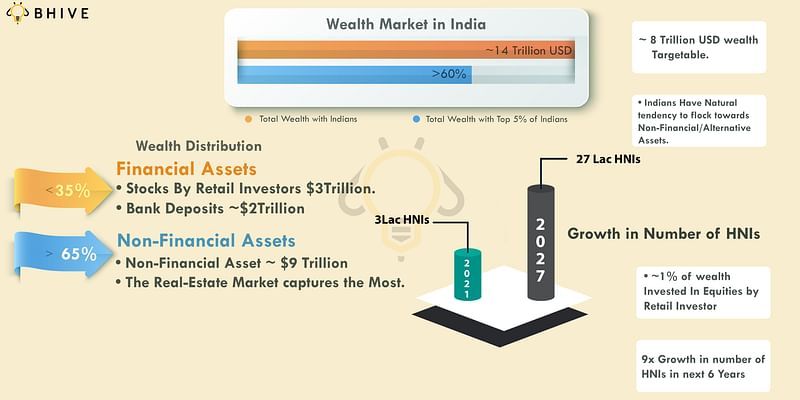
India's average net worth is booming and according to the latest report by Credit Suisse, a majority of India's wealth is held by the top 5 percent of HNI (High Networth Individuals) who own ~62 percent of India's assets. But among the 5 percent, only 0.1 percent is well served. The remaining have tried their hand at Fixed Deposits (FD), equity investments, mutual funds, residential property, etc, but they actually have the appetite to invest beyond these traditional methods. The challenge lies in the lack of accessibility to institutional-quality investment opportunities like Commercial Real Estate (CRE).
While Angel list and LetsVenture do a similar syndication deal that allows HNIs to invest in startups and alternatives, BHIVE is a similar platform, where instead of startups, you get to invest in alternative assets like Commercial Real Estate (CRE), Revenue Based Financing (RBF) and international real estate.
Today, apart from investing through BHIVE’s FinTech platform in opportunities, retail investors can now invest in BHIVE company directly as angel investors. BHIVE has oversubscribed their offering on the LetsVenture platform by around 105 percent in a week and reviews are a testament to how much people love the product and the CRE market in general.
Creating a pool of wealth for HNIs
In the Indian market, bank deposits have a cumulative value of over $2 trillion. Currently, the rates that fixed deposits are offering is just about matching the annual inflation rate. Rental yields from investing in residential apartments have also dropped to ~2.4 percent per annum which is even lower than fixed deposits. Many HNIs are exploring investing in other asset categories such as CRE that offer better monthly income plus long-term appreciation.
"Imagine, even if we’re able to capture 1 percent of this market share, we’re looking at a huge number like $20 billion of assets coming under our management over the next few years," says Shesh Rao Paplikar, Founder, BHIVE.
The need of the hour is a competitive and comprehensive platform that allows HNIs to invest in international real estate, CRE, schools, hospitals and the like. And this is where BHIVE's fintech investment platform bhive.fund comes in.
BHIVE is now in the advanced stages of closing its Pre Series A round. They saw a phenomenal response on the LetsVenture platform and are closing on the round further with a few micro VCs and well-known angel investors.
"In the third straight month of starting full-fledged sales, we hit Rs 7.76 crores of the sales in a single calendar month. This was also possible as we have been able to bring close to Rs 200 crores worth of inventory onto the platform for HNIs to invest. We realised that it’s important for us to raise $1million to $2 million in the company right away to ensure that the growth momentum continues. This money will be deployed in sales, marketing and technology before we kick off the long effort of closing on a larger Series A round. We’re quite thrilled by the response we’ve got so far on our funding round. You can expect some big announcements to come soon,” he says.
Sunitha Ramaswamy, President, Early Stage, LetsVenture says, “BHIVE has been one of the early pioneers in the co-working space and has over the years, showcased a forward-thinking attitude. They've launched BHIVE Fund for HNIs to invest in CRE and other alternative asset classes which gives much better returns compared to traditional investment options. This is indeed a great investment opportunity since a platform like BHIVE Fund helps individuals to become fractional owners as well of the property they invest in. With the team now looking to expand their full-stack services in the real estate sector, we at LetsVenture, are looking forward to working with the team.”
By the end of FY21-22, BHIVE plans to achieve an AUM (Assets Under Management) of Rs 200 crore and by the end of the next financial year, to hit the Rs 1,000 crore mark.
Sourcing the best CRE deals
While BHIVE offers Fractional Real Estate (FRE) and Revenue Based Finance (RBF) in the CRE space, the potential for CRE is immensely high, with the highest being in Bengaluru worth over Rs 20,000 crore.
While globally, the space has already picked up the pace, HNIs, here in India, are missing out on great deals. This gives BHIVE an opportunity to fill the gap by offering them investment opportunities in the deals that they were missing out on before.
"I tell people that they originally came in to be an investor in real estate, but accidentally ended up being a landlord. Who wants to get a call from his tenant in the middle of the night to fix hospitality issues? Like Blackstone, we want to bring deals to our clients that give them high returns. Our goal is to be like the Blackstone for retail investors or HNIs,” says Shesh.
He adds, “Like true investors, they need to analyse the opportunities and decide which ones to invest in and what kind of portfolio they want to build. We have a huge team that understands the nuances of the real estate market and takes the effort of scanning through a lot of properties to source the best deals. We want to ensure people spend more time on analysis of available opportunities than managing the asset, which would be the case if they themselves invested in the asset," says Shesh.
The process is simple. BHIVE acts as the dealmaker and identifies and sources the deal, structures an investable deal, syndicates the deal investments, and also manages the assets.
A niche offering led by experts
While a lot of companies offer RBF and FRE in the CRE space, there's no other platform that offers both, except BHIVE. "We're targeting HNIs who want both these products. We're taking a global outlook but targeting the Indian audience," says Shesh.
What makes BHIVE stand out is the ability to not only strike the right deals, but manage the assets through its sister concern BHIVE workspace, wherever suitable. With 130+ investors on their platform, they are a digital-first company driven by an exceptional team of founders who bring a wealth of real estate, technology and investments knowledge to the table.
“At the end of the day, what we’re building here boils down to the quality of the team in our arsenal. The comprehensive set of offerings and the credentials of the team makes the business less imitable, thus setting the barriers to market entry higher. While many are trying to do FRE, building a wealth creation platform like www.bhive.fund is extremely difficult. Hardly anybody has the kind of experience and skills the founders here have got in CRE, deal-making and leasing,” says Shesh.
He further explains, “BHIVE’s finance team is in a different league with the kind of talent we’ve been able to bring on board. Our app that is already released is already ahead of most of what others have been trying to do. Also, on a global level, we’re one of the few who have the ability to build something that goes well beyond just being FRE listing platform and to be a true wealth creation platform with multiple types of offerings, the ability to manage the assets and thereby manage the risk for investors.”
Prior to coming back to India in 2014, Shesh worked in Wall Street. He has strong experience in technology in the financial domain. Since 2014, he has been an integral part of the Bangalore startup ecosystem and has also worked closely in the Bangalore Commercial Real Estate world over the years. Shesh and Co-founder Monnappa were both classmates at the National Institute of Technology Karnataka (NITK), where they both studied Computers Engineering.
Sandeep Gupta, headed MB Invest at Magicbricks and also founded a blockchain tech startup, before joining BHIVE. In his corporate career spanning two decades, Sandeep has worked with Britannia Industries, Bombay Burmah, New Chennai Township, Cinépolis, and GMR. He holds a certificate in investment performance measurement. Sandeep is an IIM Ahmedabad (IIMA) alumnus and a CFA charter holder.
An alumnus of NITK and IIMA, Monnappa Bayavanda, before joining BHIVE, was part of the Amazon India founding team and prior to that, he was a solutions architect in i2 technologies (later JDA software and Blue Yonder).
Future outlook through the tech lens
BHIVE is on a strong growth path and is transforming the world of real estate by looking outside the regular ways of investing. In the future, they plan to diversify more into FRE and the wealth management category, and penetrate the international CRE market.
To manage the large influx of investors in CRE, technology is the only way. The bhive.fund app is available on the Google Play Store, where highly lucrative deals are made available to avid general investors. There are videos for each asset class, everyone gets a passbook, they can access investment memos and wealth analysis reports. The app will be made available on the Apple app store by the end of January 2022.
"Indians are the second biggest savers after China. We don't have the wealth mindset and don't put our money into opportunities where it can turn into wealth. We save money instead and spend it later. At BHIVE, we want to change that narrative," says Shesh.
If you have any further queries with regard to the investment, you can reach out to Ceooffice@bhiveworkspace.com.
Author :- Team YS ( )
Source :- https://yourstory.com/2022/01/bhive-fintech-investment-platform-hni-hits-monthly-revenue-1million
Date :-January 24, 2022 at 03:52PM
Brands of New India Mega Summit is just a few days away! Promising to be one of the biggest and most in-depth conferences highlighting various aspects of the country’s D2C sector, the Brands of New India will bring together founders, emerging entrepreneurs, business heads, investors, ecosystem enablers, and more. The speakers are set to add rare insights, depth, and perspectives at the Brands of New India Mega Summit.
The summit will be a two-day virtual event scheduled for January 28-29, 2022.
YourStory’s Brands of New India Mega Summit promises to bring a plethora of speakers who are making a difference and pushing the boundaries of India’s D2C segment. As a part of the newly launched ‘Brands of New India,’ this mega summit will host multiple conversations for the audience to understand the factors and enablers that have helped D2C brands, growth trajectory, current and future trends, and more.
Register now to attend the Brands of New India Mega Summit 2022 here.
Let’s take a quick look at the spectacular lineup of speakers and their sessions.
The event will see Pulkit Agrawal, Co-founder and CEO, Trell, talk about the ways in which D2C brands can use video content and vernacular language to leverage a new user base in Tier II and III. "Today, brands have realised that adoption of digital media and technology are key to help them with rapid scale. These are exciting times as the next wave of entrepreneurship is going to be from this industry and we will witness many marquee brands across categories with innovative products and solutions catering to the modern day Indian consumers,” says Pulkit.
In addition to Pulkit’s session, Bimal Kartheek Rebba, Co-founder and Chief Operating Officer at Trell will be conducting a masterclass on ‘Immersive, interactive, innovative: Taking social commerce to the next level.’
Ajith Pai, Chief Operating Officer, Delhivery will be decoding the D2C segment by sharing his perspective on the ecosystem and how logistics and supply-chain unicorn Delhivery has created a name for itself in the space.
Harshil Mathur, Co-founder and CEO, Razorpay will speak about the growth of the fintech sector in India along with his aim of building an end-to-end business financial ecosystem in the country.
Viewers will also get a chance to gather insights on key solutions and innovations that are helping the e-commerce brands to scale in a panel discussion featuring Gaurav Mangla, Co-founder and CEO, Pickrr; Akash Gehani, Co-founder, Instamojo; Prabhkiran Singh, Founder and CEO, Bewakoof; Kapil Makhija, CEO, Unicommerce; and Shankar Prasad, Founder and CEO, Plum.
Some of India’s most influential and successful female entrepreneurs such as Lizzie Chapman, Co-founder and CEO, ZestMoney and Malika Datt Sadani, Founder and CEO, The Moms Co will be sharing their perspective on the growing D2C ecosystem in India and building a holistic customer experience using innovative strategies.
Chanakya Gupta, Vice President, Strategic Partnerships and Brand Accelerator, Flipkart will participate in a fireside chat exploring the challenges, learnings, market dynamics and other key factors to keep in mind while building a D2C brand on marketplaces.
The summit will also have Sandeep Barasia, Executive Director and Chief Business Officer, Delhivery talk about the future trends and technology that’ll shape up the logistic segment and how Delhivery is strengthening India’s D2C sector; while Rohan Shanbhag, Senior Vice President, Sales, Delhivery will be participating in a panel discussion on rethinking supply chain design for D2C and omnichannel brands.
Also lined-up is an interesting session on some of the leading category creators of the D2C space. Shantanu Deshpande, Founder and CEO, Bombay Shaving Company; Chaitanya Ramalingegowda, Director and Co-founder, WakeFit.Co; Vikas Bagaria, Founder, Pee Safe; and Mohit Kumar, Founder and CEO, Business on BOT will be sharing their experiences and learnings on what it takes to think out of box and build a sustainable business that customers love.
Decoding the D2C payments playbook, Khilan Haria, Vice President, Product Management, Razorpay will be a part of a panel discussion covering the strategies, solutions and innovations that can help in improving the payment experience for D2C brands and customers.
Pushkar Shukla, Co-founder and Managing Director, Beatitude; Shivani Poddar, Co-founder and CEO, FabAlley; Jatin Gujrati, Business Head, Vedix; and Dilip Gopinath, Senior Vice President and Startup Lead, HSBC India Commercial Bank will participate in a panel discussion on trends, market dynamics, innovations, and ecosystem enablers that are fuelling the global expansion of Indian D2C brands.
Also on the roster is a leadership talk with Rhitiman Majumder, Co-founder and CMO, Pickrr where he will speak about the solutions Pickrr is using to strive for holistic customer experience.
Venkatesh Sundar, Founder and CMO, Indusface and Abhijeet Gaur, General Manager, E-Commerce, Bureau.ID will participate in a panel discussion on the solutions and innovations that help both emerging and established brands to be secure in the fast-paced D2C landscape.
Srinivas B Vijayaraghavan, Vice President - Marketing, Gupshup will participate in a discussion on Innovative customer engagement approaches for D2C brands.
Appadurai A, Country Business Manager, Graphics Solutions Industrial Business, HP will be sharing his views on how startups can benefit from tech innovations in the digital print packaging space.
So join us on January 28-29, 2022 at the Brands of New India Mega Summit to be a part of an immersive, inspiring, and unique experience with D2C startups, unicorns, policy discussions, masterclasses, and more.
Check out the Brands of New India Mega Summit event site.
Register now to attend the Brands of New India Mega Summit 2022 here.
Author :- Varnika Gupta ( )
Source :- https://yourstory.com/2022/01/d2c-ecosystem-leaders-experts-brands-new-india-mega-summit
Date :-January 24, 2022 at 03:38PM
There has been a significant increase in the number of cyber incidents and breaches being reported from across sectors. The pattern has become even more intense post the pandemic outbreak and amid increased remote working.
Another potential reason that can be attributed to the huge number of incidents is the surge in the digital transformation wave and increased online transactions. This trend was also highlighted by the Information Systems Security Association in its recent study which stated that there was a 63 percent increase in cyberattacks at the global level during the pandemic. Furthermore, India is one of the most (cyber)attacked countries in the world.
The lack of skilled talent
COVID-19, unfortunately, proved to be a lifetime opportunity for online scammers, fraudsters, and hackers.
Owing to the increasing threat vectors, having skilled professionals to counter these attacks happens to be one of the key priorities for organisations globally.
A probable reason for the increase in the number of cyberattacks is the adoption of emerging technologies such as AI, ML and increased automation as well as the lack of skilled professionals who understand such emerging technologies.
As per a study by ISC, a global non-profit firm, cybersecurity workers were taken away from their usual responsibilities to assist with other IT related works during this time.
Effective solutions
The fact of the matter is that malicious attacks and data leaks will continue to rise. With increased digitisation and an increase in the use of wallets and digital payments, cybercrimes will evolve and adapt their techniques to exploit the growing reliance on digital platforms. Hence, amidst the complex and threatening landscape and lack of skill shortage, how organisations can sail through comes as a very potent question.
To cope with such increasing threat vectors, it is imperative that organisations adopt the right set of tools and partners. This is an effective way to create a secured infrastructure and processes. It is also important to carry out regular assessments and gap identification by partnering with qualified partners.
It is indeed an undeniable fact that for an organisation, employees are their weakest link. With the ever-evolving landscape and threats coming in various shapes and forms; the dire need for organisations to invest in creating cyber awareness is the key.
Regular training and awareness sessions would help increase risk handling, enable risk mitigation practices among employees, and help build the necessary skill set.
The bottom line
As per We Forum, one out of every 61 organisations at the global level was impacted by fraud each week in 2021. However, industry experts suggest that data breaches and cyberattacks will grow with the surge in the digitisation of businesses.
The shortage of talent in the market exists due to the ever-evolving technological landscape. With the digital disruption, organisations need to upskill and reskill their workforce to bridge this talent-skill gap and eventually reduce cyberattacks as well as malicious activities.
Only a prepared and future-ready workforce will be well equipped to protect their organization from cyber threats. Hence, organisations need to grow their teams by roping in employees possessing advanced skills and expertise in cybersecurity along with incorporating cutting-edge security solutions to prevent the sudden surge in cyberattacks.
Edited by Kanishk Singh
(Disclaimer: The views and opinions expressed in this article are those of the author and do not necessarily reflect the views of YourStory.)
Author :- Kunal Bajaj ( )
Source :- https://yourstory.com/2022/01/world-sudden-surge-cyberattacks
Date :-January 24, 2022 at 03:26PM
Ola is a Bengaluru-based ride-sharing company that only a few people are ignorant of. Ever since Ola became operational in all the major cities throughout India, it has become our go-to option. Along with the US-based Uber, Ola is one of the most dominating ride-sharing companies that offers the users a wide range of vehicles and renting options to choose from!
India’s leading mobility platform, Ola has been operating since 2010, when it was founded and has already streamlined its ride-booking and car renting service and its different modes throughout these years with a focus on its users to add to its growth.
Now, Ola has also chosen to empower sustainable development and therefore, came up with its unique concept of “e-scooters” or what we term as “electric scooters”.
OLA Electric is planning to launch its Electric scooters on August 15, 2021, Ola chief, Bhavish Aggarwal disclosed it via his Twitter handle.
Thanks to all who have reserved our scooter!
Planning a launch event for the Ola Scooter on 15th August. Will share full specs and details on product and availability dates. Looking forward to it! 😀
If you have already heard about them and are curious to learn everything about electric scooters, then you can keep this article handy because here we bring you all that you would like to know about these vehicles!
Latest News
January 17, 2022 - Ola Electric hits another roadblock, the S1 scooter deliveries are delayed. However, the customers who are interested to upgrade to S1 Pro can do it easily now as the EV manufacturers will be prioritizing the production of the S1 Pro scooters, which is the choice of the majority, against a performance upgrade fee. The S1 Pro orders will start dispatching through January and February and might take up to 20 days to reach the customers' place.
December 27, 2021 - Ola Electric has expanded its authorized capital by 17,121%, increasing its capital amount from INR 22.2 Cr to INR 3,825 Cr. An IPO might follow because raising authorized capital is one of the primary steps leading a company to its conversion into a public entity.
December 24, 2021 - Ola Electric is expected to delay its production of escooters further. Though the Indian EV manufacturers have delivered nearly 100 scooters to the customers during an event earlier this month, Ola's superfactory has been operating much below its capacity, according to the sources close to the matter.
December 7, 2021 - Ola Electric raises funds from Vijay Shekhar Sharma of Paytm feat and Bollywood brother-sister duo - Farhan Akhtar and Zoya Akhtar. The subsidiary of OLA Cabs has already raised Rs 398 crore and is further looking to raise around $53 mn by allotting 371 Series C compulsory convertible preference shares (CCPS) to Temasek, IIFL, Edelweiss, Rahul Ravindra Raj Mehta, and others.
November 22, 2021 - Ola again has to postpone the delivery of the electric scooters to mid-late December 2021. The scooters that were to be delivered from October 2021 onwards had already been postponed earlier due to a global shortage of semiconductors.
November 20, 2021 - Ola founder Bhavish Aggarwal rejoiced at the amazing responses of the S1 test rides and further plans to expand the test rides to 1000+ cities across India by December 15, 2021.
October 25, 2021 - Ola launches its first Hypercharger to charge the S1 model of Electric scooters. The company is planning to start the test drive of its electric vehicles from November 10, 2021.
September 17, 2021 - Ola Electric scooters are being sold at a rate of 4 scooters each second. At the end of Day 2 of the sale, Ola has already sold Rs 1100 crores worth of scooters.
September 8, 2021 - Ola CEO and Co-founder, Bhavish Aggarwal tweets an apology for being unable to make the Ola website live for the audience to begin the purchases of Ola S1 scooters. Bhavish postpones the purchase date and time to September 15, 8 am.
September 4, 2021 - Ola Electric scooters are expected to be shipped to the US by early 2022, as mentioned by the OLA CEO, Bhavish Aggarwal.
September 4, 2021 - Ola has planned to come out with 2 products to be launched in the Indian markets: Ola S1 and S1 Pro, priced at Rs 99,999 and Rs 1,29,999 respectively.
Why Ola Electric Scooter is much like a “Revolution on two wheels”?
Yes, coming up with Ola electric scooters will certainly help people lose track of the rising costs of fossil fuels and all the morbid thoughts about the exhaustion of our fossil fuel reserves and their likes.
Ola electric is certainly a revolutionary idea and even its tagline says so “Ready or not, a revolution is coming” along with a motivating hashtag #JoinTheRevolution.
Here are the 3 key features that the Ola Electric scooter boasts of:
Big on Acceleration - The Ola electric scooters would be furnished with acceleration to envy and will allow the users to stay ahead on the road.
High on handling - Along with providing a remarkable acceleration, these bikes are also slick and promise exceptional handling on any surface.
Larger boot space - Ola Electric vehicles also come with a large boot space that is capable of storing two helmets and more important things you would need along the ride.
Ola Electric - Birth of the Entity
Ola has announced that its electricity-powered scooter manufacturing company would be different from its ride-sharing wing. They are two different lines of businesses under ANI Technologies where the former will continue to be a ride-hailing business whereas the latter would be associated with the manufacturing and selling of the electric scooters.
Ola Electric Scooters - Built, Colour Variants, Specifications, and Charging
Ola has disclosed that their electric scooters will be made available in 2 versions – the Ola Series S - Ola S1, and the top-of-the-line Ola S1 Pro. The company has already launched S1 and S1 Pro scooters with prices starting from Rs 99,999 and Rs 1,29,999, respectively.
Ola electric has acquired Etergo BV back in 2020 and announced that the Ola electric scooter is based on the Etergo Appscooter. The company has already adopted the platform of Etergo to be used in India in order to deliver better performance.
Etergo Appscooter
The Ola electric scooters will pace on 12-inch black alloy wheels. Talking about the design of the vehicles, they are clean and sleek in appearance and devoid of any other redundancies. As per the reports, the Ola e-scooters will feature a twin-pod LED headlamp that will have an LED strip running around it.
Ola electric scooter
Furthermore, these will have single-sided telescopic front suspensions and their rear shock absorbers will be mounted horizontally, with the disc brakes slotted front and in the rear. The pillion footpegs of the scooter fold flush into the bodywork of the vehicles and at the back there are chunky pillion grab handles, ending in clear-lens tail-lights.
These scooters are also claimed to be launched with the largest boot space ever, which will be capable of accommodating two half-face helmets and will have space for packing in more.
Ola Electric Scooter boot space
As per the batteries, Ola hasn’t released any formal statements concerning the battery system of the vehicles but its batteries will not be of a swappable type according to most. It will rather run on a standard charging system.
Ola electric scooter’s riding range for the S1 model is 121 km and for its S1 Pro model, it is around 181 km per charge. The latter also includes the Hyper Mode, which is not present in the former model.
Ola's electric scooters are reported to be equipped with a 7.0-inch TFT color display that will feature in-built navigation, onboard diagnostics, and other infotainment functions, and will be powered by an Android operating system.
Ola has already roped in Wayne Burgess, a Jaguar design veteran who also served as the Design Director of Jaguar Production and SVO Vehicles, and plans to make their vehicles big on design, bringing in the global appeal to the vehicles.
Wayne Burgess
Besides, Ola is also planning to launch an indigenously built car in order to foray into the electric four-wheeler industry, which will also get a major boost in its design with Burgess leading their team as the VP of Design.
Matte black, matte pink, matte sky blue were some of the color options that were disclosed by Ola initially. However, currently the S1 Pro model comes in 10 different colours, which are:
Midnight Blue
Matt Black
Millenial Pink
Liquid Silver
Anthracite Grey
Porcelain White
Neo Mint
Marshmellow
Jet Black
Coral Glam,
wheras, the S1 model of Ola Electric scooters comes in 5 colours - Porcelain White, Midnight Blue, Coral Glam, Jet Black, Marshmellow.
The owners of Ola Electric vehicles will be able to charge their scooters using a standard 5A socket or at one of its ‘Hypercharger’ charging stations. The company has already announced that it will make the stations live for charging scooters in over 100 cities initially, which will eventually cover over 400 cities.
The first Ola Electric Hypercharger was launched on October 25, 2021, ahead of the planned test drives of the Ola electric vehicles scheduled for November 10, 2021. The S1 test rides of the vehicles have already started, and have received an encouraging response from all across the country, as per the reports of November 20, 2021. Furthermore, witnessing the overwhelming response that Ola S1 scooters have received, Bhavish Aggarwal, Co-founder and CEO of Ola, has decided to extend the test rides to over 1000 cities by December 15, 2021.
Amazed and proud to see the strong response to our S1 test rides! Thousands of you have tried & loved it! We’re now expanding test rides to 1000+ cities across India by Dec 15. This is the largest direct to consumer outreach in Indian automotive history! #JoinTheRevolutionpic.twitter.com/ErxXkflQzO
The electric vehicles of Ola are currently manufactured in its electric scooter factory in Tamil Nadu, which has a capacity of producing 2 million vehicles annually and the numbers will rise to 10 million by the end of 2022.
Yes, Ola Electric is in process of building its factory, OLA FutureFactory in Tamil Nadu, which will cover an area of more than 100 acres, boast a production capacity of 10 million units per year, and will operate with the help of over 3000 AI-powered robots.
It is believed to be the world’s largest 2 wheeler factory that is planned with the facilities to roll out 1 vehicle every 2 seconds. Phase 1 of the plant is nearly complete.
What will be the price of Ola Electric Scooters?
The website of the Indian multinational ride-sharing company initially declared that the Ola e-scooters would be competitively priced. According to sources close to Ola, these scooters were expected to be priced around Rs 1 lakh mark.
The prices, as unveiled, are tagged at Rs 99,999 and 1,29,999 for S1 and S1 Pro models respectively. At this price segment, these vehicles will compete with the likes of the Bajaj e-Chetak, Ather 450X, and TVS iQube.
If you are eager to purchase one of such vehicles, then you don’t have to worry anymore because here are some easy steps that will help you book your vehicle:
First, you need to visit the official website of Ola electric: www.olaelectric.com and then click/tap on the ‘Reserve for Rs 499’ button, which appears at the top-right corner of your screen.
Now, you need to enter your mobile number, click on the captcha verification box to verify the same, and then click/tap on the Next option.
You will then receive an OTP on your mobile number, which you will need to type in and then click/tap on the Next option.
Then you will get a dialog box that says ‘Total Payable – Rs 499’ and will offer 3 payment options – Debit/Credit card, UPI, and Netbanking.
After that, you need to choose your preferred payment option, after which you will be redirected to the payment gateway.
After making the payment you will see the final screen, which will confirm your Ola booking by saying “Congrats, you are now part of the revolution."
As soon as you have completed making the payment, you will receive the order ID and other details via SMS or email to the mobile number and the email address provided.
Funding received by Ola Electric Mobility
Ola Electric Mobility, the subsidiary of Ola responsible for manufacturing Ola Electric scooters has raised a total funding of $607.2 million to date over 7 funding rounds and is powered by 8 investors in total.
The lead investors of Ola Electric Mobility include big names like Softbank, Tata Sons Private Limited, Matrix Partners India, Tiger Global Management, Hyundai Motor Company, Kia Motors, and more.
Ola Electric is now looking to raise around $1 billion in the upcoming months. To funnel in the money from the equity firms and international investors, the company has already started its collaboration with JP Morgan, which has a network of equity firms, financial investors, strategic traders, and other large-scale investors. The company had already raised $100 million from the Bank of Baroda in July 2021 in order to kickstart the first phase of the construction of the largest two-wheeler factory.
Ola Electric raises funds close to $200 million on October 1, 2021, from Falcon Edge, Softbank, and others to elevate its valuation to $3 billion. The recent funds would be used to boost the development of its other vehicle platforms, including electric motorbikes, mass-market scooters, and electric cars.
The company is further looking for its upcoming funding round worth $200 mn, which would be led by a couple of US-based bluechip tech funds along with its existing investors. This will reportedly boost the valuation of the four-year-old startup, Ola Electric, by over 60% to $5 bn. The company has finally succeeded in raising the fund it was looking for. Ola Electric raised over $200 million from a clutch of investors including Tekne Private Ventures, Alpine Opportunity Fund, Edelweiss, and others, to elevate its valuation to $5 bn, as per the reports dated January 24, 2022.
Ola Electric has raised funds equal to Rs 398 crore, as per the reports dated December 8, 2021, from a bunch of investors including Vijay Shekhar Sharma, who has poured in Rs 75 crore via VSS Investco; Farhan and Zoya Akhtar, who have invested around Rs 21 crore and Rs 10.7 crore, and from Ritesh Sidhwani, who has pumped in Rs 21.4 crore along with other investors Edelweiss, IIFL and others. This investment might also increase in the upcoming months. The EV manufacturing arm of OLA is also looking to raise around $53 Mn by allotting 371 Series C compulsory convertible preference shares (CCPS) to Temasek, angel investor Rahul Ravindra Raj Mehta, IIFL, Edelweiss, and a clutch of other investors. Ola Electric, after these recent rounds of funding, is valued at over $5 bn, as of December 7, 2021.
OLA Electric has raised $860.2+ mn via over 9 funding rounds that the company has seen. The last Ola Electric funding round was raised on January 24, 2021, where the company raised over $200 mn.
Here's a glimpse into all the prominent funding rounds that OLA Electric has seen so far:
Date
Stage
Amount
Investors
January 24, 2022
-
$200+ mn
Tekne Private Ventures, Alpine Opportunity Fund, Edelweiss, and others
December 8, 2021
Series C
$53 mn
Temasek Holdings
September 30, 2021
Series C
$200 mn
Alpha Wave Global, Softbank
July 12, 2021
Debt Financing
$100 mn
Bank of Baroda
March 12, 2020
Series B
$1 mn
Pawan Munjal Family Trust
September 16, 2019
Corporate Round
-
Kia Motors, Hyundai Motor Company
July 2, 2019
Series B
$250 mn
Softbank
May 6, 2019
Series A
-
Tata Sons
March 1, 2019
Series A
$53.58 mn
Marix Partners India, Tiger Global Management
Pre-Sale Bookings and Sales Records for the Ola Electric Scooters
Ola opened the option for pre-booking their customers on July 15, 2021. Therefore, everyone who was eager to buy the much-awaited e-scooters, and wanted to stay ahead of their peers could pay a refundable deposit amount of Rs 499.
Ola electric vehicles have witnessed pre-bookings of more than 1 lakh vehicles, as reported on July 17, 2021, the numbers of which increased each second.
The purchases for Ola Electric scooters were geared to start from September 8, 2021, and the brand was set to kickstart the delivery of the products from October 2021, as of the website status on August 2021. The brand also mentioned then that the purchase of the S1 Pro vehicles will be starting from September 8, 2021, and the Ola scooter delivery will tentatively begin from October 2021 onwards. The booking for Ola S1 and S1 Pro had already started back then and you can also find it live on their website as well as the Ola app even today.
However, Ola S1 scooters couldn't be bought on the mentioned date due to technical glitches in the developer's end of the website that failed to make it up and running. The website that would be a one-stop solution for digital purchases, which would also guide the customers with a fully digital loan process without any paperwork, wasn't live on September 8, 2021. Ola co-founder and CEO Bhavish Aggarwal apologized on Twitter for the frustrating experience the customers had to go through and postponed the purchase date to September 15, 8 am. He further reassured that the reservation of the customers in the purchase queue will remain unchanged.
The purchase of the Ola e-scooters went live on the mentioned date, September 15, 2021, at the end of which it was declared by Bhavish Aggarwal that Ola Electric sold 4 scooters/second, which resulted in the sale of scooters worth Rs 600 crores+ in a single day. The total sale of Day 2 was even better as goes the Twitter post of the Co-founder of Ola Cabs, Bhavish Aggarwal:
Day 2 of EV era was even better than Day 1! Crossed ₹1100Cr in sales in 2 days! Purchase window will reopen on Nov 1 so reserve now if you haven't already.
Ola is also looking to transport their electric scooters to the US by early 2022 as part of its international trade. The CEO of the company, Bhavish Aggarwal has mentioned,
"Yes soon! We will be shipping to the US by early next year,"
in a reply to Vivek Wadhwa, a US-based entrepreneur on Twitter, who earlier referred to the Ola Electric scooters as "the Tesla of Scooters," further adding, "would love to get one here in Silicon Valley."
Ola, however, had to postpone the deliveries of the e-vehicles from the month of October to November 2021 due to a global semiconductor shortage. However, the delay has further extended, as per the reports dated November 22, 2021, where the company has decided to defer the first batch of deliveries of its e-scooters to December 15 - 30, 2021, which was earlier expected to happen between October 25 - November 25, 2021.
Ola Electric - Brand Ambassadors
Ola Electric has already been a grand pre-booking success and is innovating its marketing strategies to attract the present generation of customers. The company has already roped in Bhuvan Bam, singer, songwriter, actor, and one of the most popular YouTubers of India, famous for his Youtube "BB ki Vines," as its brand ambassador to hook in the young generation of buyers.
Bhuvan Bam was hired on August 27, 2021, on a contractual basis, the agreement of which declares that the popular Youtube personality would collaborate with the electric scooter manufacturers to create entertaining and eccentric content revolving around the new-age Ola Electric scooters.
Bhuvan Bam seemed thrilled to be an Ola Electric brand ambassador and said,
“I am really happy that Ola Electric considered me as one of their ambassadors. It’s truly exciting to be a part of this green revolution, something I’ve always wished for. The scooters are sleek, attractive, and are designed as per the Indian electric vehicle market. I have joined the green revolution already and I can’t wait for everyone to get their hands on it.”
FAQ
How much does Ola electric scooter cost?
The Ola electric scooter has 2 models -
Ola S1 is priced at Rs 99,999.
Ola S1 Pro is priced at Rs 1,29,999.
What is the range of Ola electric scooter?
The range of Ola Electric scooter on a single charge are -
Ola S1 - 121 kms
Ola S1 Pro - 181 kms.
What is the top speed of Ola Electric scooter?
The top speed of Ola Electric S1 is 90km/hr whereas for the S1 Pro model the top speed is 115km/hr.
Author :- Anik Banerjee
Source :- https://startuptalky.com/ola-launch-electric-scooter/
Date :-January 24, 2022 at 11:45AM